

Introducing the Schmeltzerizer
Turning policy briefings back into stories.
On this substack, I’ll often take underwhelming messaging and run it through the 8-point storytelling rubric I laid out in my first big post. Rather than re-explain it every time, this post will serve as the reference.
And because, like Henry Martin — the egomaniacal chemist who created the Martinizing process for one-hour dry cleaning — I, too, am going to take this opportunity to christen this process after myself. Behold, The Schmeltzerizer™
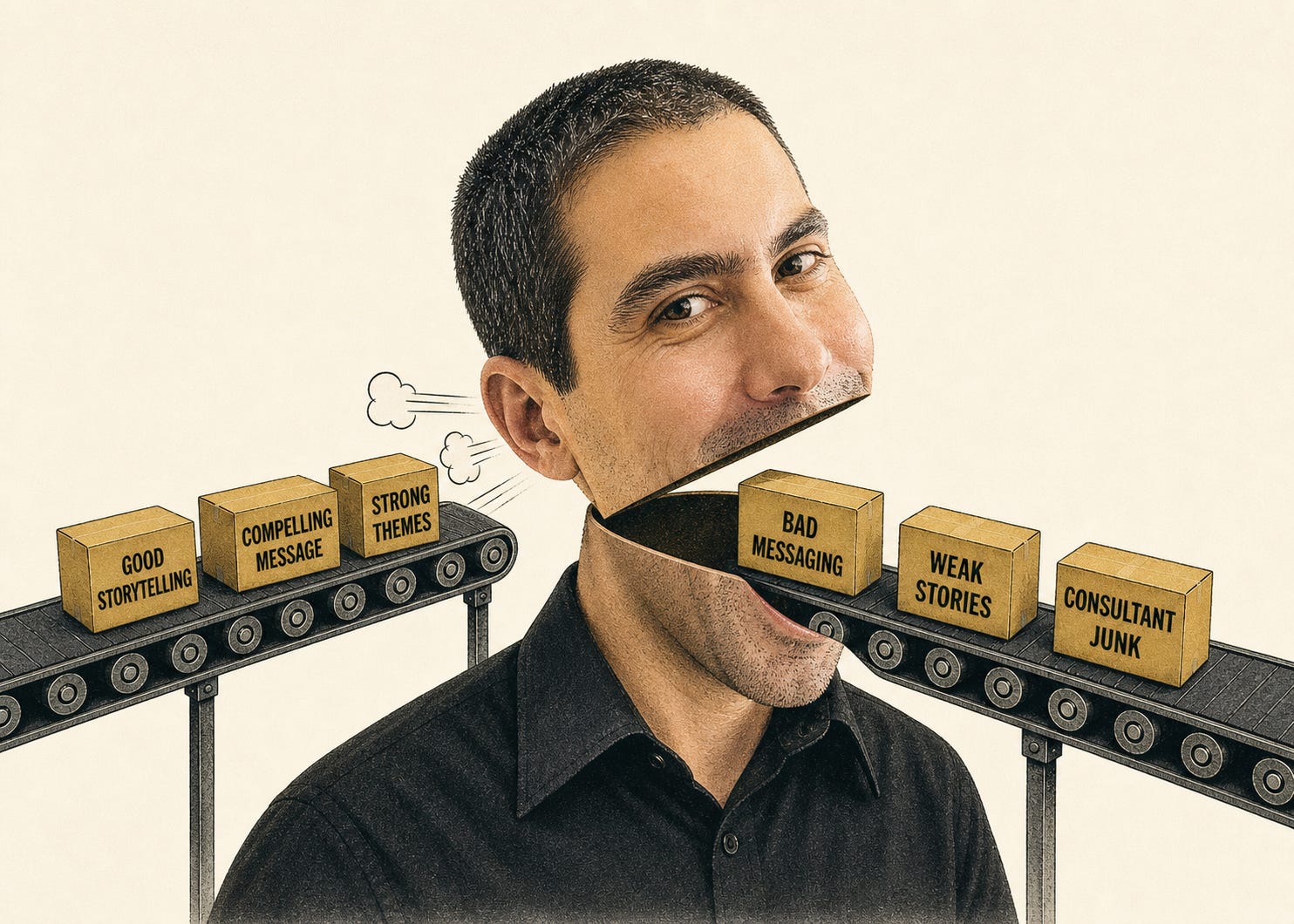
The Schmeltzerizer takes any message and runs it through eight points, measuring whether it includes:
The Protagonist — Who is this story about? Who are we rooting for?
The Protagonist’s Want — What do they need? What are they reaching for?
The Antagonist — Who or what is standing in the way?
The Antagonist’s Want — Why are they standing in the way? What do they get out of it?
The Plot — How did we get here? What’s the journey from problem to resolution?
The Stakes — What happens if the protagonist wins? What happens if they lose?
The Urgency — Why now? Why does this moment matter?
The Theme — What is this really about, underneath the specifics?
Wherever a message fails, the Schmeltzerizer fixes it.
So let’s turn this one up to 11, shall we?
The Child Tax Credit Flop
Let’s take a look at a monumental moment for Democrats — when they passed the Child Tax Credit coming out of COVID. This actually wasn’t a completely new program. It had a history. There was a real story here to tell, to bring people in, to make them aware of what was being achieved, and with the help of which party. There was a chance to name and shame the antagonist. Did President Biden and Democrats do that? Let’s take a look.
On July 15, 2021, the first monthly checks went out. President Biden came out to mark the moment. And to be clear up front: this wasn’t one speech in a series. This was the speech. There was a web video after, and he mentioned it in other speeches. But there was no sustained campaign. It’s one of the reasons that Joe Manchin felt emboldened to kill it just a short time later. Anyway, this was the chance. Here’s how he took it, in his own words:
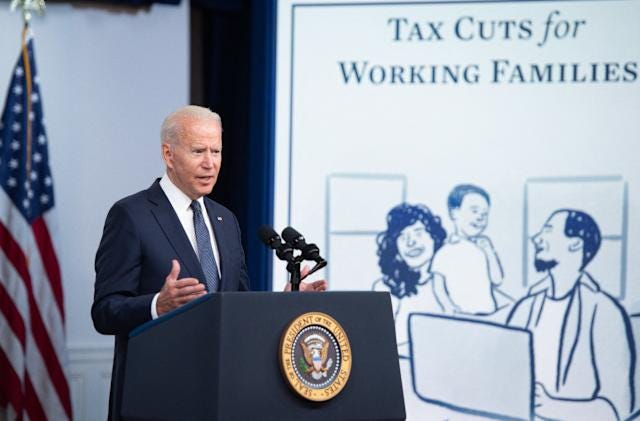
“Folks, it’s a pleasure to be here… I believe this is actually a historic day — a historic day in the sense that we continue to build an economy that respects and recognizes the dignity of working-class families and middle-class families. It’s historic and it’s our effort to make another giant step toward ending child poverty in America. I think this will be one of the things that the Vice President and I will be most proud of when our terms are up… This has the potential to reduce child poverty in the same way that the Social Security reduced poverty for the elderly…
This is a middle-class tax cut. When I came up — when I decided I wanted this in the legislation, I referred to it in the way it really is: It’s a middle-class tax cut…
Today, these tax cut payments are arriving automatically. But it didn’t happen automatically — the result of the work that people who did this, advocating for this for a long, long time…
You’ll probably hear from our Republican friends — all who voted against this — but they’ll tout the success as it helps working families in their states and their districts…
We shouldn’t let child poverty continue to stain the conscience or drag down our economy. And so, I say to my colleagues in Congress: This tax cut for working families is something we should extend, not end, next year…
Millions of children and their families — starting today, their lives are about to change for the better. And our country will be better off for it as well. This is a really good day.”
And before anyone says I cherry-picked the worst lines: I cherry-picked the best ones. These are the moments where Biden came closest to telling a story: the opening, the historical comparison, the acknowledgment of the fight, the naming of opponents, the closer. What I cut was more technocratic, not less: income thresholds, IRS deposit codes, payment amounts, and an apology for using too many wonky terms.
Now let’s run that against the eight points:
✅ The Protagonist. Working-class families and middle-class families is a clear, identified protagonist. Categorical rather than individuated, but he knows who the story is about. In another part of the speech he talks about an email he got from a woman but it’s not in this part.
🟡 The Protagonist’s Want. Partial. A little bit of breathing room, his father’s phrase, is a real want. Later: braces, a tutor, sports equipment. Small and transactional—household-budget level, not a national claim about what working families are owed.
❌ The Antagonist. Missing. Our Republican friends and my colleagues in Congress. That isn’t an antagonist. That’s a colleague you’re slightly annoyed with.
❌ The Antagonist’s Want. Missing. He never explains why anyone would oppose helping American families raise their children.
🟡 The Plot. Partial. Didn’t happen automatically… advocating for this for a long, long time acknowledges a fight existed and names the fighters. He never describes the fight itself. Gestured at and dropped.
❌ The Stakes. Missing. Stains the conscience. No description of what happens to a specific kid or family if this fails.
❌ The Urgency. Missing. Most proud of when our terms are up. Tell your kids when they’re 25. Past tense before the present has begun.
❌ The Theme. Missing. The speech bounces between dignity, tax relief, Social Security, child poverty, and hypocrisy without committing to any of them.
Scorecard: 1 hit. 2 partial. 5 misses.
But the count actually undersells the failure. Even where Biden hits or partially hits, the elements never appear together. The protagonist is in paragraph two. The want is four paragraphs later. The plot is at the end, as a thank-you to colleagues. They are never in contact with each other. They are never in conversation. A story isn’t a checklist of elements — it’s elements in tension, pressing against each other, building toward something.
One real victory announced as if it were a disjointed press release.
Bing Bang Boom Clang: Schmeltzerize It
Now let’s run it through the Schmeltzerizer.
For too long, working families in America have been told to wait.
Wait for wages to catch up to the cost of raising a kid. Wait for childcare to become something other than a second mortgage. Wait for a country rich enough to put a man on the moon and a billionaire in space to figure out how to help a mother in Toledo afford her son’s basic needs. Wait, wait, wait.
Today, the waiting ended.
This morning, in tens of millions of American homes, parents opened their bank accounts and saw a check from the United States government, sent to them because they are raising the next generation of Americans, and that work matters. Three hundred dollars for every child under six. Two hundred fifty dollars for every older child. Every month. And if we have anything to say about it, every month after that.
Remember this morning. Remember where you were when you heard. Because today is the day the Democratic Party stopped apologizing for believing that government should show up for working families and started showing up again.
This is what Democrats used to do. Ninety years ago, when our grandparents were growing old in poverty, it was Democrats who signed Social Security into law. When children worked twelve-hour shifts in factories and lost fingers in machines, it was Democrats who ended child labor and put those kids in schoolrooms instead. When seniors couldn’t afford a doctor, it was Democrats who built Medicare. We did big things. We did them on purpose. And the country we built on the other side of those fights is the country every American takes for granted today.
Then somewhere along the way, we forgot how. Today, we remembered.
And we are setting our sights on something we should have ended a long time ago: child poverty in America. We are going to put it in the history books — the thing our grandchildren cannot believe we ever tolerated, the way we cannot believe we ever sent eight-year-olds into coal mines.
Now, let’s be honest about who is going to try to stop us, and why. Every Republican in Congress voted against this. But Republicans are not the real story. The real story is the handful of billionaires and corporations who fund their campaigns and write their tax bills, and who understand something most Americans haven’t been told plainly enough: a country that takes care of its children is a country where the people at the top have less power over everyone else.
That is what this fight is actually about. Not budgets. Not deficits. Power. Every dollar that goes to a working family is a dollar that doesn’t go to someone who already owns three houses. Every parent who isn’t desperate is a parent who can say no to a bad job, vote their conscience, raise a kid who expects more from this country. The richest of the rich have spent forty years making sure working families stayed exactly desperate enough to be controllable. Today, we made them a little less controllable. And those corrupt interests are going to come for this credit with everything they have, because they understand exactly what it means.
So this is not the end of the fight. This is the start of a new one. The law lasts a year. If we lose, three million children fall back into poverty by Christmas, and the people who took it from them will be richer for it.
That cannot happen. Not after how long it took to get here. You, me, the Democratic party, we’re going to wage a campaign to make this credit permanent.
So, remember who made today happen. And remember who fought against it, and why. And remember that the Democratic Party is fighting for you again.
Now let’s run that against the same eight points.
✅ The Protagonist. Working families, same as Biden. Named in the opening line and carried through to the close. The Toledo mom gives the class a face without locking the speech to a single individual.
✅ The Protagonist’s Want. A country that stops making them wait. A country where raising a child isn’t a financial emergency. The end of being kept exactly desperate enough to be controllable. Stated as a national claim, not a household budget item.
✅ The Antagonist. The donor class; billionaires and corporations who fund campaigns and write tax bills. Republicans named as their vehicle. Specific, structural, durable.
✅ The Antagonist’s Want. Power. Explicitly stated: a country that takes care of its children is a country where the people at the top have less power over everyone else. The motive isn’t budget concerns or work requirements — it’s leverage over working people, and the speech says so out loud.
✅ The Plot. Forty years of waiting. Democrats who used to fight and forgot how. Working families who got tired of waiting. A party that remembered. An ambition to end child poverty the way we ended child labor. And now, a joint effort to beat back the powerful and make this credit permanent. That’s a story arc and a journey that people are on.
✅ The Stakes. Concrete and loss-framed. Three million children back in poverty by Christmas. The Toledo mom’s three hundred dollars gone. The people who took it from them richer and more powerful over us.
✅ The Urgency. The law lasts a year. The opposition is already coming. This is not the end of the fight. This is the start of a new one.
✅ The Theme. Democrats getting back to fighting for working families, the way they used to. Carried from the second paragraph through the historical spine to the closing line. Every section returns to it.
Scorecard: 8 hits. 0 partial. 0 misses.
And unlike President Biden’s speech, the elements appear in contact. The protagonist’s want is established in the same paragraph the protagonist appears. The antagonist and their want are stated together. The stakes attach directly to the protagonist. The plot threads through every section. The theme is the spine, not a one-liner. The ingredients are in the same dish.
Note what didn’t happen. The policy didn’t change one iota. It’s good policy. Damned good policy. And I have to stress this: Yes, Democrats of the 1990s and 2000s had some middling policies. But they also have some great policies, especially starting with the Biden Administration.
So, I’m not out to remake policy. I’m trying to show how good policy needs a good story. How it deserves a good story.
That is what the Schmeltzerizer does.